
Zoe Braun · 19 October 2026
Advocacy Efforts Target Daylight Requirements in Upcoming Affordable Housing Projects
Advocacy organizations across multiple regions have intensified campaigns to raise daylight standards in affordable housing developments scheduled for construction between 2027 and 2030, and these groups cite studies linking natural light exposure to improved resident well-being and lower energy costs. Researchers from various institutions have documented how insufficient daylight in dense urban housing correlates with higher rates of seasonal affective disorder, while building codes in several countries still permit minimal window-to-floor ratios that fall short of emerging health guidelines.
Groups such as the International Housing and Daylighting Alliance along with national tenants' rights coalitions have submitted formal recommendations to planning authorities in the United Kingdom, Canada, and Australia during 2025 consultations. These proposals call for mandatory minimum daylight factors of at least 2 percent in living areas and 1.5 percent in bedrooms for all new subsidized units, and the recommendations draw on findings published by the Canada Mortgage and Housing Corporation that tracked 1,200 households over five years and found measurable improvements in sleep quality and reduced reliance on artificial lighting after daylight upgrades.
Current Regulatory Landscape and Proposed Changes
Existing building regulations in England require average daylight factors above 1 percent in kitchens and living rooms under the Building Regulations Approved Document L, yet advocacy submissions argue that these thresholds need upward revision to reflect updated research on vitamin D synthesis and mental health outcomes. Similar reviews are underway in New South Wales where state housing authorities have opened comment periods that close in October 2026, and parallel efforts in British Columbia seek to embed daylight metrics directly into provincial affordable housing procurement contracts.
Data collected by the Australian Housing and Urban Research Institute shows that properties meeting higher daylight thresholds achieve 18 percent lower annual electricity consumption for lighting compared with code-minimum builds, and this evidence has been presented at multiple public hearings attended by developers and local councils. Observers note that several major contractors have begun incorporating larger clerestory windows and rooflights into schematic designs for upcoming projects in Manchester and Melbourne even before formal rule changes take effect.
Key Stakeholders and Implementation Timelines
Tenants' unions in London and Toronto have organized workshops to train residents on submitting daylight impact statements during planning applications, while academic teams at the University of Sydney continue to model shadow patterns for high-density sites using updated climate data. These models incorporate projected increases in cloud cover through 2040 and demonstrate how current window sizing formulas may need adjustment to maintain consistent interior illuminance levels.
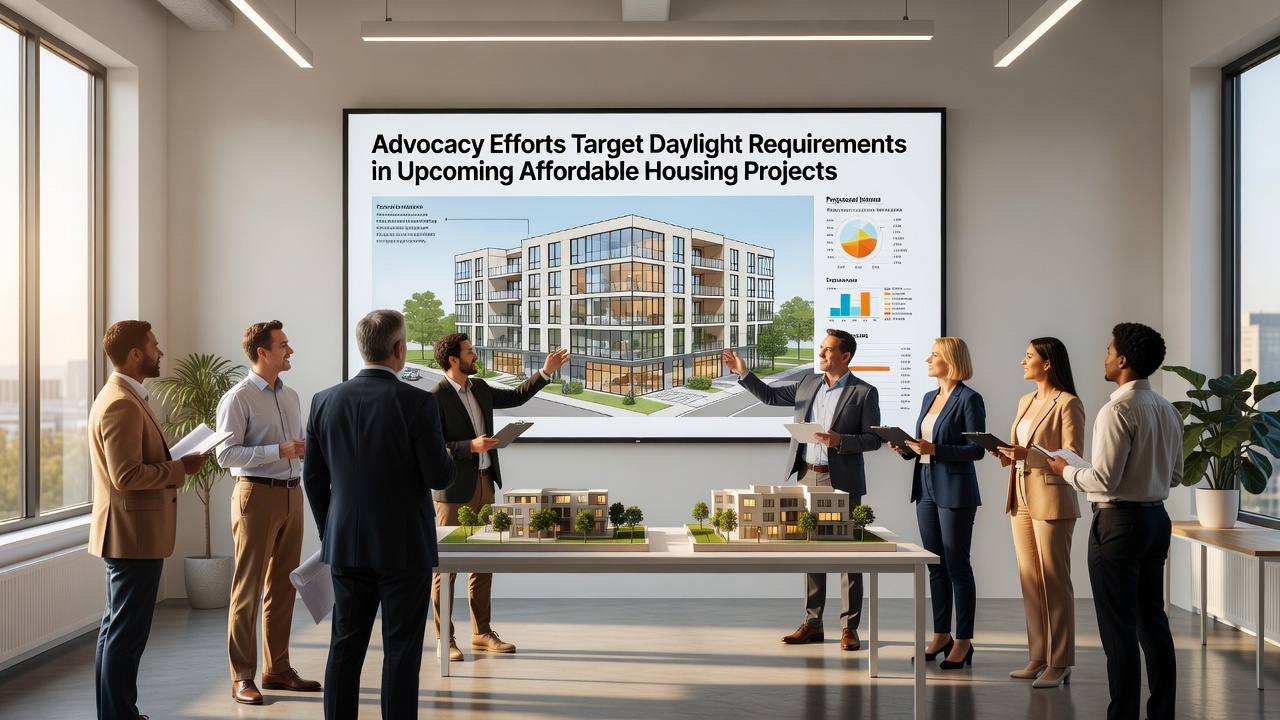
Policy analysts at the European Commission’s Directorate-General for Energy have referenced daylight provisions in draft updates to the Energy Performance of Buildings Directive, and these references suggest member states could receive additional scoring credit for exceeding baseline daylight targets in social housing tenders. Municipalities in Vancouver and Glasgow have already piloted daylight audits on three 2024 completions and reported that retrofitting decisions made at the design stage proved far less costly than later modifications.
Evidence from Recent Projects and Monitoring Efforts
Longitudinal monitoring programs launched in 2023 by the University of British Columbia tracked 340 households in newly completed affordable blocks and recorded average daily light exposure increases of 47 minutes when rooflights were added to north-facing units. These results have been shared with advocacy networks that are now pressing for similar features to become standard rather than optional in future bids.
Procurement documents released in September 2025 by several English local authorities include optional daylight bonus points that can improve a developer’s scoring during competitive tendering, and early indications show multiple bidders responding with enhanced window schedules and light wells. Coordination between these authorities and national bodies continues through quarterly working groups that will finalize guidance ahead of the October 2026 deadline for updated national model codes.
Conclusion
Advocacy efforts continue to shape the technical specifications that will govern daylight performance in the next wave of affordable housing, and the outcomes of ongoing consultations will determine whether higher thresholds become mandatory across multiple jurisdictions. Continued data collection from occupied buildings and further refinement of simulation tools will inform the final policy language adopted by planning departments worldwide.